
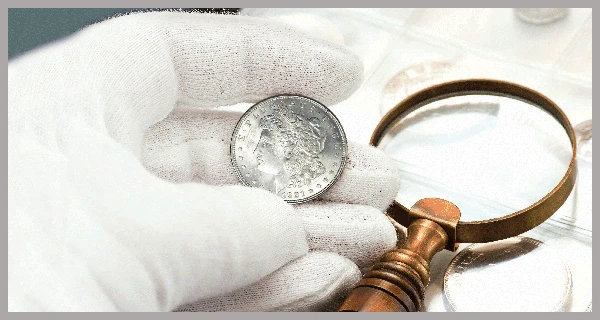
How to Grade Morgan Silver Dollars
Jun 23rd 2026
Two Morgan Dollars from the same year can look nearly identical and still be worth very different amounts. The difference almost always comes down to one thing: grade.
Understanding coin grading doesn't mean you need to become an expert overnight (sorry, that’ll take years!). But knowing the basics can make you a more confident collector and help you avoid costly mistakes when buying or selling. Here's a simple overview of how Morgan Dollar grading works.
Understanding Morgan Dollar Grading
Morgan Dollars are graded using the Sheldon scale, a 70-point system created by Dr. William Sheldon in 1949 and used by every major grading service today. The scale runs from 1 (barely identifiable) all the way to 70 (perfect and flawless under magnification).
In practical terms, coins fall into two broad categories: circulated and uncirculated. Circulated coins (grades 1–58) show wear from actual use. Uncirculated, or Mint State, coins (grades 60–70) were never spent, but can display varying degrees of contact marks from the actual coining process and subsequent storage in bulk bags at the mint.
The most commonly collected grades for Morgans are:
- Good to Fine (G–F): Heavily worn but recognizable. Great entry-level coins.
- Very Fine to Extremely Fine (VF–EF): Clear details with some wear. Popular with budget-conscious collectors.
- About Uncirculated (AU): Minimal wear, most luster intact. Strong value for the grade.
- Mint State (MS-60 to MS-65+): No wear. Quality is determined by luster, strike sharpness, and surface marks.
What Graders Actually Look At
When evaluating a Morgan Dollar, experienced graders focus on a handful of key things.
Wear on the High Points
Wear shows up first on the highest areas of the design: Liberty's cheek and the hair above her ear on the obverse, and the eagle's breast feathers on the reverse. These are the first places to check. The obverse carries more grading weight than the reverse, especially Liberty's cheek and the open field beside her face.
Luster
Uncirculated Morgan dollars are famous for exhibiting the “cartwheel effect,” which refers to the way mint luster appears to rotate (like the spokes of a wheel) across the coin’s surface when tilted under a light. As a coin circulates, wear and handling disrupt the original luster. . A Morgan with full, unbroken luster indicates that the piece remains in mint state condition.
Strike Quality
Some Morgan Dollars were struck more sharply than others. New Orleans Mint issues, especially from the late 1880s and 1890s, are known for softer strikes, meaning details can look flat even on uncirculated coins. On the other hand, San Francisco was in possession of the latest minting technology of the time, and produced sharper strikes overall; the 1878-1882 Morgans minted there are often singled out by numismatists as some of the series’ best-struck issues. Knowing the typical strike for a given date and mint helps you grade more accurately.
Surface Marks
Because Morgans were shipped in large canvas bags of 1,000 pieces, bag marks are common even on uncirculated examples. Fewer, lighter marks can mean a higher Mint State grade. Cleaning is also something to watch for: a cleaned coin often looks unnaturally bright and shows fine hairlines under magnification, which lowers its grade and collector appeal considerably.
Common Grading Mistakes
A few pitfalls trip up newer collectors when grading Morgans:
- Mistaking a weak strike for wear. If the luster is intact but details look soft, it's likely a strike issue, not circulation wear.
- Overgrading cleaned coins. Bright doesn't always mean better. Look for hairlines and unnatural color under magnification.
- Ignoring the fields. The flat background areas show marks clearly under light, and they matter just as much as the design details.
Why Certified Coins Take the Guesswork Out
Learning to grade is a skill that develops over time, which is exactly why professional certification services like PCGS and NGC exist. When a coin is certified, it's examined by multiple trained graders, assigned a numeric grade, authenticated, and sealed in a tamper-evident holder.
For Morgan Dollar collectors, certification means you know exactly what you're getting. It also protects against counterfeits and altered mint marks, which are a real concern with key-date Morgans. Certified coins in grades like MS-63, MS-64, and Gem MS-65 are the most actively traded and collected.
At ICCOIN, we carry a wide selection of certified Morgan Dollars across grades, dates, and mint marks. Whether you're starting out or adding to an established collection, our inventory is a great place to explore.
Final Thoughts
Grading Morgan Dollars is one of those skills that gets easier the more coins you handle. Start with what you have, study the key design points, and don't be afraid to compare your coins to certified examples.
The more you look, the more you'll see, and that's a big part of what makes collecting so enjoyable.